


How to Choose a Nitrogen Generator Manufacturer for Reflow Soldering
When selecting a nitrogen generator for reflow soldering, buyers often start by asking whether the equipment can produce 99.999% nitrogen and how much it costs.
Both questions matter, but they should not come first.
The real process target is the oxygen level inside the reflow oven. Nitrogen purity at the generator outlet does not directly equal the residual oxygen level inside the oven. Oven design, entrance and exit openings, conveyor lanes, PCB loading, exhaust settings, and sealing conditions can all affect the actual result.
A qualified manufacturer should therefore be able to assess the operating conditions, explain the sizing basis, and define practical acceptance criteria.
1. Does Every Reflow Oven Need High-Purity Nitrogen?
No.
Nitrogen helps reduce oxidation of pads, component leads, and molten solder. It can improve the process environment for solder wetting and joint formation, but not every reflow process requires the same nitrogen purity or residual oxygen level.
The target should be determined according to:
-
Solder paste and flux chemistry;
-
PCB surface finish;
-
Component and pad solderability;
-
Wetting, bridging, solder-ball, and tombstoning targets;
-
BGA, QFN, power-device, or other special process requirements;
-
Customer specifications and reliability requirements;
-
Actual defect data from production trials.
The process team should first define the acceptable oxygen range inside the oven. The required nitrogen purity and flow can then be determined from the oven specifications and actual production conditions.

2. Information Required Before Equipment Selection
Reliable sizing requires more than the number of production lines.
Reflow oven
Confirm:
-
Manufacturer and complete model;
-
Number of heating and cooling zones;
-
Single-lane, dual-lane, or multi-lane configuration;
-
PCB width, spacing, and conveyor speed;
-
Nitrogen inlet pressure and recommended flow;
-
Oxygen monitoring and closed-loop control;
-
Oven sealing, entrance and exit design, and exhaust settings.
Two ovens with the same number of zones may still have different nitrogen requirements.
Process target
Confirm:
-
Target residual oxygen level in ppm;
-
Oxygen measurement location;
-
Whether the target applies to an empty or loaded oven;
-
Permitted oxygen variation;
-
Current soldering defects and baseline data.
Generator outlet purity and oxygen measured inside the oven must be treated as separate parameters.
Flow and operating schedule
Confirm:
-
Average and peak flow for each oven;
-
Purge demand during start-up;
-
Number of ovens operating simultaneously;
-
Daily operating hours and annual operating days;
-
Other equipment sharing the nitrogen supply;
-
Production-line expansion plans.
If no reliable flow data is available, conduct a short-term measurement before selecting the nitrogen generator.
Pressure and compressed air
Confirm:
-
Required pressure at the oven inlet;
-
Pipe length, diameter, and expected pressure loss;
-
Available compressed-air pressure and flow;
-
Pressure dew point, oil content, and particle level;
-
Air-treatment equipment and installation conditions.
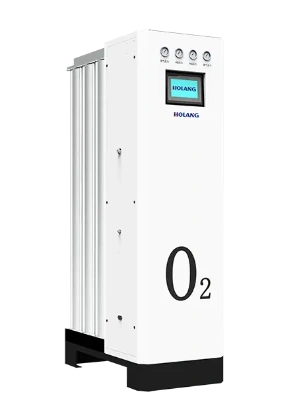
The HOLANG NPL product page specifies an inlet pressure of 0.7–1.0 MPa and requires compressed air that complies with ISO 8573-1:2010. The required particle, water, and oil classes should still be stated clearly in the formal technical proposal.
3. What Should Be Compared Besides Purity?
Ask every supplier to quote against the same operating data.
| Item | What to Confirm |
|---|---|
| Effective output | Flow at the specified purity, pressure, and temperature |
| Purity adjustment | How output changes when purity is adjusted |
| Pressure stability | Outlet pressure and minimum pressure at the oven |
| Peak response | Purging and simultaneous operation of multiple ovens |
| Air consumption | Compressed-air demand at the specified output |
| Air quality | Required dew point, oil, particles, and filtration |
| Monitoring | Purity, flow, pressure, alarms, and off-spec gas handling |
| Expansion | Ability to add modules and reserve pipework capacity |
| Maintenance | Service intervals, spare parts, and required access |
| Acceptance | Test conditions, instruments, duration, and responsibilities |
Flow values should also use the same units and reference conditions. Standard-state flow, actual-state flow, and equipment display values cannot always be compared directly.
4. Cylinders, Liquid Nitrogen, or On-Site Generation?
There is no universal answer.
Nitrogen cylinders may suit low consumption, intermittent production, or temporary trials. Check cylinder-change frequency, storage, transport, and supply continuity.
Liquid nitrogen may suit larger demand and clearly defined high-purity requirements where tank, vaporiser, and delivery conditions are available. Evaluate storage, rental, delivery, evaporation losses, and interruption risks.
On-site nitrogen generation may suit continuous and relatively stable demand where adequate compressed air and installation space are available. The calculation should include equipment, electricity, air treatment, maintenance, spare parts, and redundancy.
Do not assume a fixed savings percentage or payback period. Compare the three options using actual consumption, operating hours, local prices, and total life-cycle cost.
5. When May the NPL Series Be Considered?
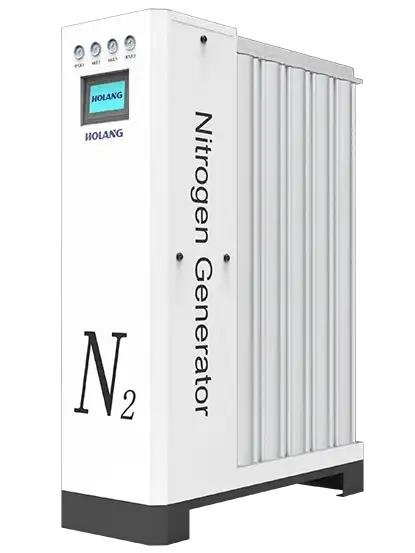
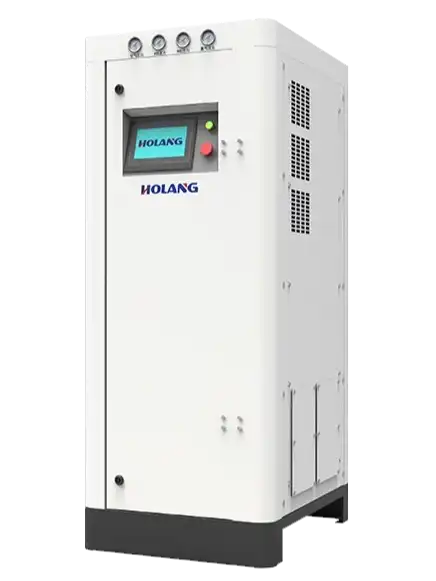
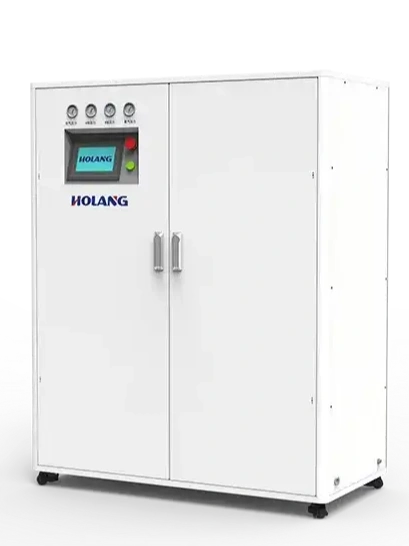
The HOLANG NPL series uses PSA pressure swing adsorption technology and has a modular design. According to the published product information, the series offers:
-
Adjustable nitrogen purity from 95% to 99.999%;
-
Compact installation;
-
Adjustable purity and flow;
-
Modular expansion;
-
Monitoring of key operating parameters.
It may be evaluated for continuous reflow-soldering applications with suitable compressed air, limited installation space, or future expansion requirements.
However, a specific model cannot be selected from the industry name alone. Final sizing must consider required purity, peak flow, pressure loss, compressed-air conditions, redundancy, and expansion plans.
The maximum available purity should not automatically become the operating setpoint. The correct setting should be based on the required oven oxygen level and verified soldering results.

6. When Should a Manufacturer Refuse to Select a Model?
A specific model should not be recommended when key information is missing, including:
-
Reflow oven manufacturer and model;
-
Conveyor configuration;
-
Target residual oxygen level;
-
Required flow and pressure;
-
Compressed-air capacity and quality;
-
Number of ovens operating simultaneously;
-
Operating schedule and expansion plan.
Selecting a model too early can result in insufficient capacity, unnecessary energy use, limited expansion, or acceptance disputes.
7. Recommended Acceptance Conditions
The technical agreement should define:
-
Nitrogen purity, flow, and outlet-pressure test conditions;
-
Compressed-air pressure, temperature, and quality;
-
Test instruments and flow reference conditions;
-
Purge time and steady-state test duration;
-
Performance with multiple ovens operating;
-
Oxygen measurement point and board-loading condition;
-
Alarm handling, maintenance, and spare-parts responsibilities;
-
Capacity reserved for future expansion.
Data from another installation may be useful as a reference, but it cannot replace the oven specifications and site testing for the current project.
Contact HOLANG
Holang (Suzhou) Energy Technology Co., Ltd.
Chinese legal name: 昊朗(苏州)能源科技有限公司
Address: No. 51 Jinsigang Road, Wuzhong District, Suzhou, Jiangsu Province, China
Service hotline: 400-0512-711
Email: marketing@holangchina.com
Request a Preliminary Assessment
Please provide:
-
Reflow oven manufacturer and complete model;
-
Number of existing and planned production lines;
-
Current supply method: cylinders, liquid nitrogen, centralised supply, or another method.
If available, also provide the target oxygen level, nitrogen flow, supply pressure, and compressed-air conditions.
Submit your oven model, number of production lines, and current gas supply method to receive a preliminary nitrogen supply assessment.
Service hotline: 400-0512-711
