


When purchasing a nitrogen generator, many companies begin by asking:
“Can the purity be increased further?”
“If we are going to invest in one, why not choose 99.999% directly?”
“Higher-purity equipment must be better and safer.”
These assumptions may sound reasonable, but they can lead companies in the wrong direction from the very beginning of equipment selection.
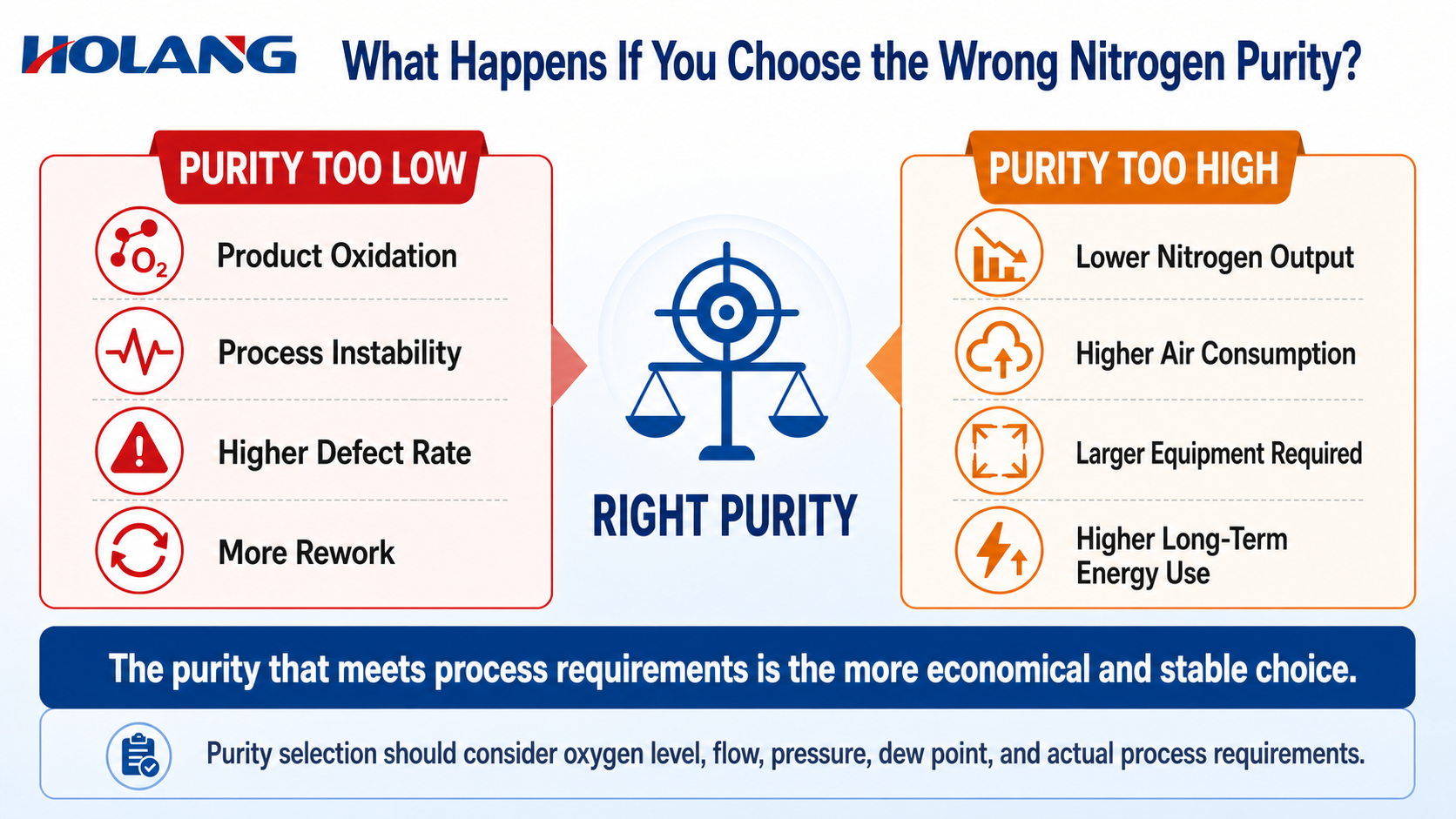
Higher nitrogen purity is not always better. The right approach is to balance purity, flow, pressure, energy consumption, and capital investment while still meeting the actual process requirements.
1. Why Does Cost Increase as Purity Rises?
A PSA nitrogen generator uses compressed air as its feed gas. It separates nitrogen from oxygen by utilizing the different adsorption characteristics of carbon molecular sieves.
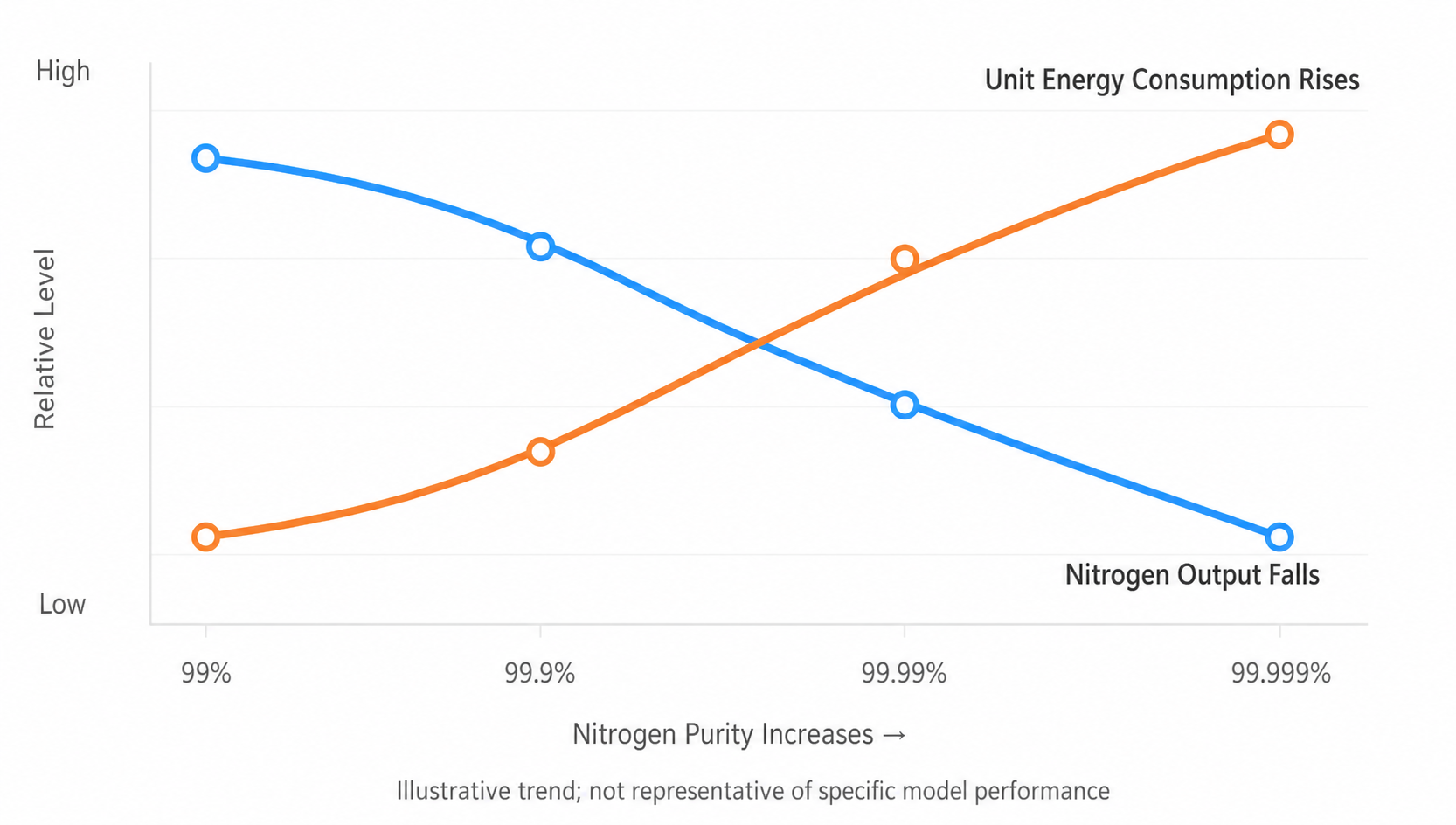
Under the same equipment conditions, higher nitrogen purity generally requires stricter control of the oxygen content. As a result, the amount of nitrogen the system can produce usually decreases.
If a company requires higher purity without reducing nitrogen output, it may need to:
-
Increase the compressed-air supply;
-
Select a larger nitrogen generator;
-
Upgrade the air drying and filtration system;
-
Increase the initial equipment investment;
-
Accept higher operating energy consumption.
Increasing purity from 99.9% to 99.99% may appear to mean adding only one more “9,” but it can require a different system configuration and lead to higher operating costs.
If a production process only requires 99.9% nitrogen, blindly selecting 99.999% will not automatically improve product quality. Instead, it may result in unnecessary long-term energy consumption.
2. What Should Companies Really Focus On?
Nitrogen purity is only one parameter within a complete nitrogen supply system.
In actual production, companies should also consider:
-
The allowable oxygen content at the point of use;
-
Nitrogen flow during normal operation and peak demand;
-
The required inlet pressure of the production equipment;
-
Nitrogen dew point and gas cleanliness;
-
Continuous operating hours;
-
Pressure fluctuations when multiple machines use nitrogen simultaneously;
-
Instantaneous gas demand during start-up purging and atmosphere recovery.
At some production sites, the nitrogen generator may indicate that the required purity has been reached, while the oxygen content inside the production equipment remains unstable.
In such cases, the problem may not be insufficient nitrogen purity. It may instead be caused by pipeline leakage, inadequate flow, pressure fluctuations, or poor purging efficiency.
Therefore, determining whether a nitrogen supply system is suitable requires more than checking the purity value displayed on the nitrogen generator. Companies must also evaluate the actual process results after the nitrogen reaches the point of use.
Reaching the specified purity is only the foundation. The ultimate goal is to deliver stable nitrogen to the point of use and meet the actual process requirements.
3. Different Industries Require Different Nitrogen Purities
3.1 SMT Reflow Soldering
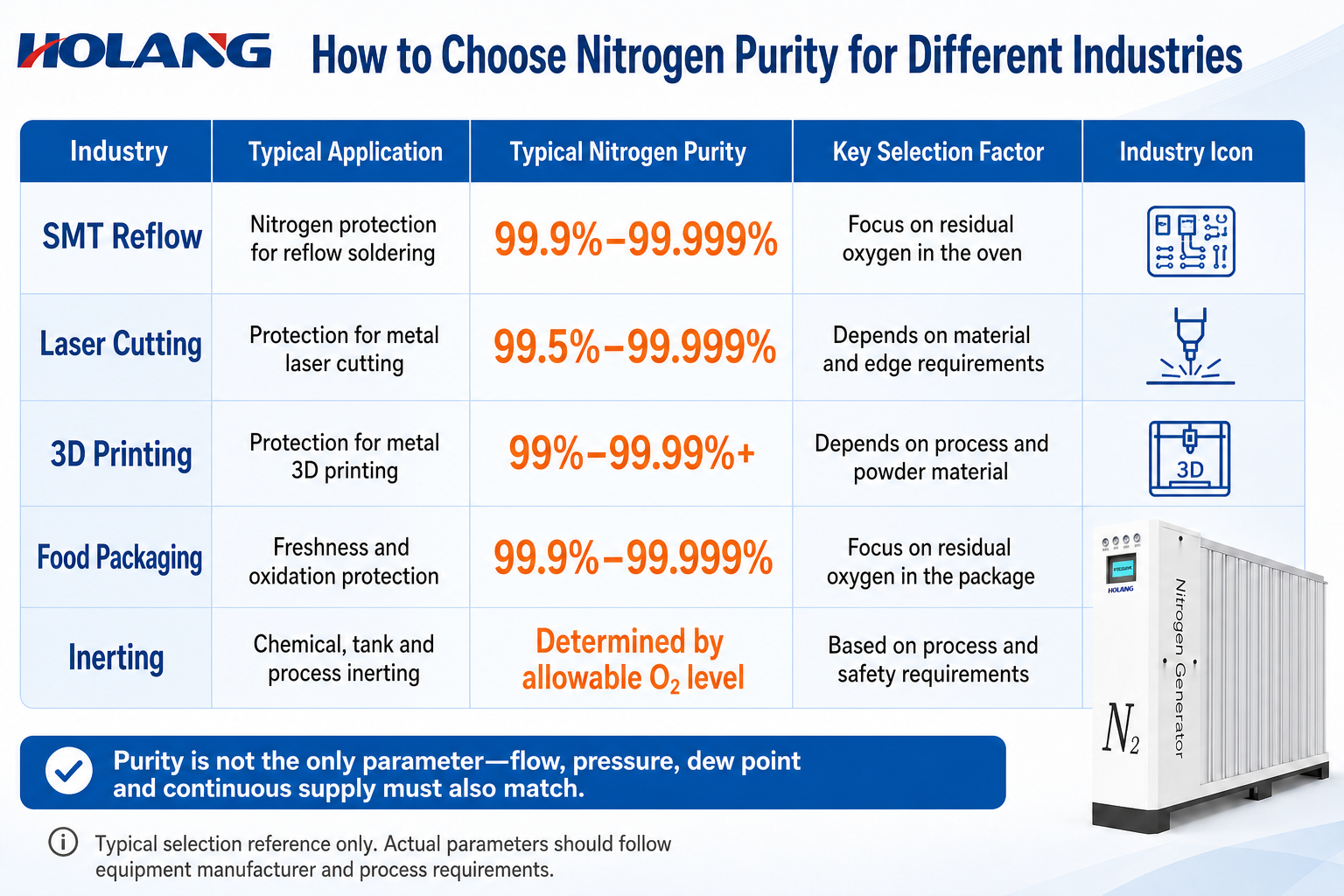
In SMT reflow and wave soldering processes, nitrogen is primarily used to reduce oxygen levels inside the soldering oven and minimize oxidation of the solder and pads.
Standard electronic products, automotive electronics, medical electronics, and high-density PCBs do not have the same soldering atmosphere requirements.
Some processes can begin with an evaluation at 99.9% nitrogen purity, while high-reliability products often require 99.99% purity or higher.
In SMT applications, the actual oxygen content inside the reflow oven is often more important than nitrogen purity alone. Equipment sealing, production speed, and nitrogen flow must all be considered.
3.2 Laser Cutting
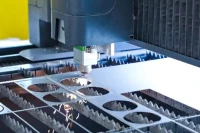
In laser cutting, nitrogen is mainly used to isolate oxygen, remove molten material, and reduce oxidation along the cut edge.
For conventional stainless steel and aluminum cutting, an appropriate nitrogen purity can be selected according to material thickness, edge color, and downstream processing requirements.
Special materials such as titanium alloys, or products with strict cut-edge oxidation requirements, may require higher nitrogen purity.
Laser cutting also requires high instantaneous flow and pressure. If a company focuses only on increasing purity while ignoring the nitrogen booster, storage tanks, and pipeline design, problems such as yellowing, dross formation, and pressure drops may still occur.
3.3 3D Printing
Different 3D printing processes and materials have different requirements for the protective atmosphere.
Some nylon powder applications may use nitrogen at a relatively lower purity. Metal powder bed fusion typically places greater emphasis on the oxygen content inside the build chamber, and certain processes may require nitrogen purity of 99.99% or higher.
Nitrogen demand during the initial chamber-purging stage also differs from the demand during stable printing.
Equipment selection should therefore consider purging speed, pressure stability, and the ability to supply nitrogen continuously throughout long printing cycles.
3.4 Food Packaging
Nitrogen is used in food packaging to reduce residual oxygen, slow oxidation, and help protect the physical condition of the product.
Potato chips, nuts, coffee, milk powder, and edible oils use different packaging methods and have different shelf-life requirements. Their requirements for nitrogen purity and residual oxygen are therefore not identical.
Food manufacturers should determine their gas supply standards according to product characteristics, packaging speed, target residual oxygen levels, and applicable food safety requirements.
A single nitrogen purity should not automatically be applied to every product.
3.5 Chemical, Pharmaceutical, and Inerting Applications
In tank blanketing, material transfer, reactor purging, and oxidation prevention, the required nitrogen purity is generally determined by the allowable oxygen content, material properties, and process safety requirements.
Because these applications involve process safety, nitrogen purity must be selected according to the company’s process documentation, risk assessment, and applicable standards. It should not be determined by experience alone.
4. How to Select the Correct Nitrogen Purity
Before determining the required purity of a nitrogen generator, companies should follow these steps.
Step 1: Confirm the Process Requirements
First, review the technical requirements provided by the production equipment manufacturer, material supplier, and internal process documentation.
Confirm whether the process specifies nitrogen purity, allowable oxygen content, or both.
Step 2: Inspect the Actual Gas-Use Environment
Confirm the pipeline length, equipment sealing performance, number of gas-use points, workshop temperature, and existing compressed-air conditions.
Step 3: Calculate Flow and Pressure Requirements
Determine the normal flow, peak flow, operating pressure, start-up purging time, and simultaneous demand from multiple machines.
Step 4: Conduct On-Site Testing
Where conditions allow, test different nitrogen purities during trial operation or trial production.
Observe product quality and equipment performance to identify a suitable purity that can consistently meet the process requirements.
Step 5: Evaluate Long-Term Costs
Compare equipment investment, compressed-air consumption, electricity costs, maintenance expenses, and future expansion requirements.
Do not evaluate a system solely by its maximum purity specification.
The goal is not to pursue the highest possible specification, but to meet actual process requirements reliably at a reasonable total cost.
5. Why Does HOLANG Emphasize On-Demand Nitrogen Generation?
HOLANG believes that the appropriate nitrogen purity should not be determined by equipment marketing specifications. It should be determined by the customer’s actual process requirements.
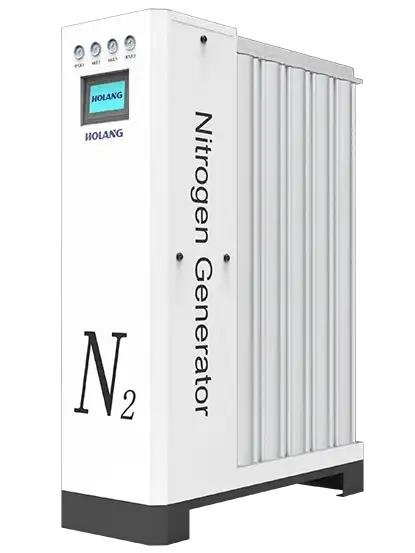
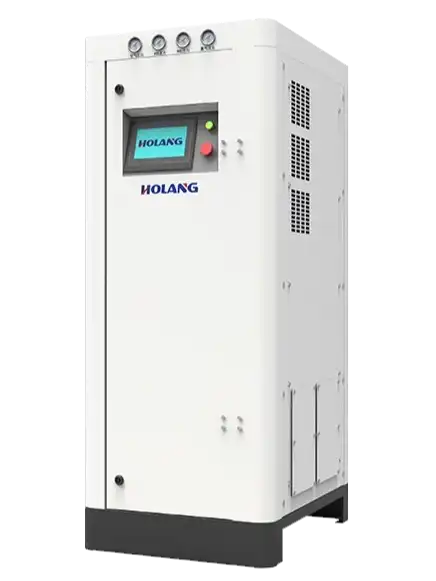
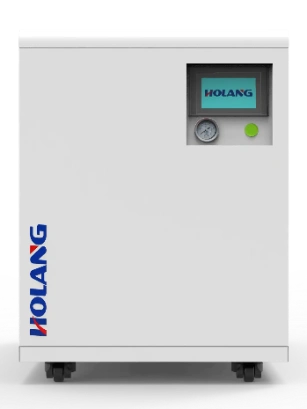
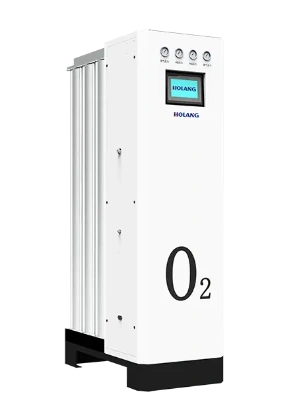
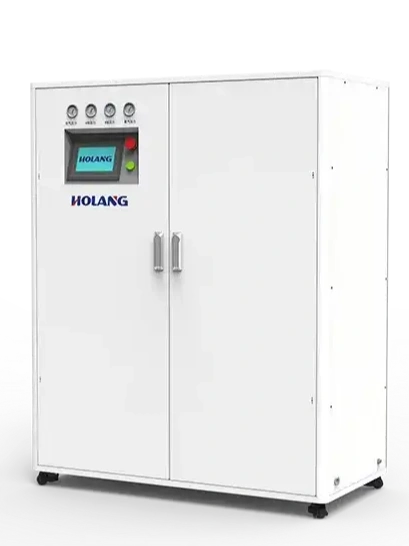
HOLANG modular nitrogen generators use PSA technology and can be configured according to the purity, flow, and pressure requirements of different industries.
They are suitable for:
-
SMT electronics manufacturing;
-
Laser cutting;
-
3D printing;
-
Food packaging;
-
Other industrial inerting and protection applications.
When designing a nitrogen generation solution, HOLANG focuses on understanding:
-
The customer’s industry and specific production process;
-
The nitrogen purity or oxygen content required by the equipment;
-
Normal and peak nitrogen flow;
-
Operating pressure and dew point requirements;
-
Daily operating hours;
-
Future production expansion plans;
-
Existing air compressors and compressed-air treatment conditions.
For companies with multiple production lines or fluctuating nitrogen demand, modular configurations, gas storage buffers, and online monitoring can also be used to improve the flexibility and stability of the nitrogen supply system.
HOLANG does not recommend pursuing the highest possible nitrogen purity without considering the actual application.
Instead, we help customers select a nitrogen supply solution that meets process requirements while maintaining a reasonable total cost.
Conclusion
Nitrogen purity is not a competition of numbers.
Insufficient purity may affect product quality. Excessively high purity may increase equipment investment and long-term energy consumption.
A professionally designed nitrogen generation system should achieve the right balance among purity, flow, pressure, stability, and operating cost.
Before selecting a nitrogen generator, companies should first answer one question:
Does the production process really require the highest possible purity, or does it require nitrogen that is stable, suitable, and economical?
If you are evaluating a nitrogen generator, you can provide HOLANG with information about your industry, number of machines, purity requirements, nitrogen flow, operating pressure, and operating hours.
We will help you develop an on-site nitrogen generation solution based on your actual operating conditions.